Wednesday, December 31, 2008

Four Reasons to Love CouchDB, Part 2 | A.J. Brown's Blog

Four Reasons to Love CouchDB, Part 2 | A.J. Brown's Blog: 


"Reason #2: It’s not a RDBMS"

RDMS’s are powerful, but sometimes they’re overkill for our applications. I’ve seen some hypothesis suggesting that CouchDB’s document oriented strategy would work for 90% of web applications today. Who knows how accurate that is, but it definitely makes you think. After all, you can’t get any more cutting edge than a database engine asking us to rethink how we model data which is written in a language that asks us to rethink parallel processing.

Check back tomorrow for Reason #3

Monday, December 29, 2008

6. The Web Layer

Grails documentation for mapping Rails-like routes

Sunday, December 28, 2008

Web Reflection: Stressfull procedure? Distribute your task!

Web Reflection: Stressfull procedure? Distribute your task!: "Have you never been in troubles with frozen GIFs or unresponsive HTML?
Sometimes JavaScript could be used to perform really stressful task and a loop, a for in, or an each, could not be fast enough to make your DOM responsive."

FriendFeed Blog: Simple Update Protocol: Fetch updates from feeds faster

FriendFeed Blog: Simple Update Protocol: Fetch updates from feeds faster: "SUP (Simple Update Protocol) is a simple and compact 'ping feed' that web services can produce in order to alert the consumers of their feeds when a feed has been updated. This reduces update latency and improves efficiency by eliminating the need for frequent polling."

Friday, December 26, 2008

Pragmatic Programming Techniques: CouchDB Implementation

Pragmatic Programming Techniques: CouchDB Implementation
Ricky Ho from Adobe: "To understand deeper about CouchDB design, I am very fortunate to have a conversation with Damien, who is so kind to share many details with me. Here I want to capture what I have learnt from this conversation."

Wednesday, December 24, 2008

Ten Practical Search Engine Marketing (SEM) Tips — crowdSPRING Blog

Ten Practical Search Engine Marketing (SEM) Tips — crowdSPRING Blog

InfoQ: Damien Katz Relaxing on CouchDB

InfoQ: Damien Katz Relaxing on CouchDB: "In this interview, Damien Katz talks about CouchDB, a distributed, fault tolerant, document oriented database developed by Apache Incubator."

Upload API

Upload API: "Uploading a video to Vimeo using the Advanced API is pretty simple. Your application will need to have write permissions for the user before you can upload a video to their account.

1. Get an Upload Ticket
2. Post the Video
3. Get the Video ID"

Vimeo Developer API

Vimeo Developer API

Tuesday, December 23, 2008

Database Disruption From The Couch � Daniel Tsadok’s Weblog

Database Disruption From The Couch � Daniel Tsadok’s Weblog: "CouchDB itself makes ActiveRecord (and other fancy ORM’s, like Hibernate) largely obsolete (and even quaint)."

Friday, December 19, 2008

CouchDB nearly completed, looks for customers in cloud - SD Times On The Web

CouchDB nearly completed, looks for customers in cloud - SD Times On The Web: "When Damien Katz started the CouchDB project in 2005, he wanted to create a better Lotus Notes. As a veteran engineer of the Lotus Notes project, Katz had written code both for and in Notes, and he had a distinct sense of what was valuable there. Thus, he decided to build a slimmer document management system designed specifically for the Web world. Now, three years and two programming languages later, CouchDB is approaching version 1.0."

Thursday, December 18, 2008

Official Google Blog: @Twitter: Welcome to Google Friend Connect

Official Google Blog: @Twitter: Welcome to Google Friend Connect


"We know many of you enjoy using Twitter to see what people are talking about and to let others know what you've been up to, whether it's sharing a YouTube video or checking in on your friend's tweets. To help you and your Twitter network stay connected no matter where you are on the web, we're excited to announce that Google Friend Connect has integrated with Twitter. This means that when you join a friend connected site, you can choose to use your Twitter profile, discover people you follow on Twitter who are also members of the site, and quickly tweet that you have found a cool website."

Wednesday, December 17, 2008

Good Math, Bad Math : Databases are hammers; MapReduce is a screwdriver.

Good Math, Bad Math : Databases are hammers; MapReduce is a screwdriver.

Relax with CouchDB Book

Relax with CouchDB: 


"The book is designed to guide you gently through using CouchDB with clear but practical scenarios. We progressively showcase key features, starting with simple document CRUD, working through to advanced MapReduce, and culminate with deployment tuning for performance and reliability."

Sample chapters:
Part I. Introduction 
Part II. Learning CouchDB

Tuesday, December 16, 2008

CouchDB & Related Links

Labnotes � CouchDB: Thinking beyond the RDBMS

A flat document storage engine calling itself a database? On any other day, that’s what you’ll get from a collaboration between a vendor and PR agency, pushing new ways to achieve synergy and optimize the bottom line to Global 5000 companies.

This day, it happens to be CouchDB. And CouchDB on first look seems like the future of database without the weight that is SQL and write consistency.

also of interest:  READ CONSISTENCY: DUMB DATABASES, SMART SERVICES

Programming CouchDB with Javascript - plok

To illustrate how easy and straightforward writing applications for CouchDB is, we are going to build a simple todo-list application in Javascript. You should be familiar with HTMLand Javascript and the DOM. You do not need any Ajaxexperience. Although we are going to use it, all will be abstracted away.

CouchDb PHP Hello World Tutorial - plok

This HowTo explains how to write PHP applications that use CouchDb as there data storage. It assumes you are familiar with PHP’s syntax and at best you already wrote some code for a project. It’s also good to know about databases and how and why to use them in PHP applications. If you never heard about classes and objects, you might be able to follow the examples anyway, so don’t worry about that.


Introduction to Parallel Programming and MapReduce - Google Code University - Google Code

Introduction to Parallel Programming and MapReduce - Google Code University - Google Code: "This tutorial covers the basics of parallel programming and the MapReduce programming model."

Monday, December 15, 2008

CouchDBX Revival - plok

CouchDBX Revival - plok: "If you want to play with CouchDB on your Mac and you don’t want to mess with any command line installation business, this is for you."

Couch Db Binaries ‎(brunomlopes‎)

Couch Db Binaries ‎(brunomlopes‎): "This is a repository for my build of the binaries required to run CouchDb on Windows (32bit version, hasn't been tested on any other enviroments)."

Racklabs TechTalk: CouchDB featuring Jan Lehnardt Part 1 on Yahoo! Video

Racklabs TechTalk: CouchDB featuring Jan Lehnardt Part 1 on Yahoo! Video: "Most data is not inherently relational. CouchDB takes this idea and provides a data storage model that easily accommodates modern applications’ needs. Instead of doing the equivalent of manual memory management in a database, splitting all data up..."


Part 2 here

The Windows Command Line, Batch Files, and Scripting- Using the Command Shell

The Windows Command Line, Batch Files, and Scripting- Using the Command Shell

Saturday, December 13, 2008

Stop treating Ajax as something special

Stop treating Ajax as something special


Everyone wants slick applications that use Ajax to reduce page loads and make it feel, well, more application-ny. Of course this is all done in a progressively enhanced way, so the page works just as well without JavaScript.

The problem is, that sometimes, there's an overhead of the extra work to support the Ajax responders.

If you stop treating Ajax as something special, you'll find it's barely any extra work on the server side.

Thursday, December 11, 2008

Playing with Hibernate and JPA under NetBeans

This articleis a good place to start An Introduction to Java Persistence for Client-Side Developers it introduces JPA Java object persistence to an audience unfamiliar with Java enterprise stuff. 

JPA is an object persistence API, one implementation of which is Hibernate which is an ORM layer between your Java code and an SQL database. Hibernate/JPA handle the mapping back and forth. 

The article uses a light java database HSQLDB which can run as a file based or memory based database though any jdbc connected database should work.

The article consists of 2 Java files and an XML config file, to get these running under NetBeans I did the following:

I created a project.

Then I created a place for the config file: META-INF off the src directory and placed the persistence.xml file in there. To create folders in NetBeans click the parent folder (eg Source packages) select New > Other > Folder if it isnt already in the list of types.

I then added the two Java files under a package "addressbook"

META-INF
    persistence.xml

addressbook
    Person.java
    Main.java

Then I downloaded a the HSQLDB stuff and placed it in a directory. I added the hsqldb.jar to the project. 

Hibernate Support was already an installed Plugin on my copy of NetBeans 6.5. Under the Tools > Libraries page I found a few libraries to select from. The library needs to support annotations and a bunch of logging things so I added the Hibernate JPA library to my project. That was all I needed.

Next I set up a script to run HSQLDB as a separate process

java -classpath lib/hsqldb.jar org.hsqldb.Server

and ran the NetBeans project which did as it was expected to do.

Wednesday, December 10, 2008

Spinning Guyro: Google & I

Spinning Guyro: Google & I

I was brushing off my Java skills the other day. It's been a little while and I ran into a task I could not, from memory, recall how to write. So I turned to Google and quickly came up with this post from 1996(!) on the subject:

From: Lawrence Page

I have a web robot which is a Java app. I need to be able to set the User-Agent field in the HTTP header in order to be a good net citizen (so people know who is accessing their server). Anyone have any ideas?

Right now, Java sends a request that includes something like:

User-Agent: Java/1.0beta2

I'd rather not rewrite all the HTTP stuff myself. I tried just searching in the JDK for the Java/1.0beta2 figuring I could just change the string, but I couldn't find it. Perhaps it is stored as a unicode string?

An easy method of setting the User-Agent field should probably be added to Java, so people can properly identify their programs.

Thanks, Larry Page

Hmm, I wonder what kind of "web robot" this Larry Page was working on and hope his project was successful!

Does it bode well for me that I ran into the same question?


Apache CouchDB: The CouchDB Project

Apache CouchDB: The CouchDB Project


Read the introduction and the technical overview to learn more about the design and basic concepts of CouchDB.

Sam Ruby: Dare Takes a Look at CouchDB

Sam Ruby: Dare Takes a Look at CouchDB: "What replaces a Department table in a typical Company/Employees database (or one that identifies a Group in a Facebook like appication) when faced with the prospects of mega-sharding?� The CouchDB answer is views, ones that are computed by map/reduce jobs that essentially extracts (or maps) “tags” and “social relations” from profile documents and reduces them into documents of their own right."

Labnotes � CouchDB: Thinking beyond the RDBMS

Labnotes � CouchDB: Thinking beyond the RDBMS: "I’m personally convinced that write consistency is the reason RDBMS are imploding under their own weight. Features like referential integrity, constraints and atomic updates are really important in the client-server world, but irrelevant in a world of services."

Sunday, December 07, 2008

lighttpd fly light

lighttpd fly light: "Security, speed, compliance, and flexibility -- all of these describe lighttpd (pron. lighty) which is rapidly redefining efficiency of a webserver; as it is designed and optimized for high performance environments. With a small memory footprint compared to other web-servers, effective management of the cpu-load, and advanced feature set (FastCGI, SCGI, Auth, Output-Compression, URL-Rewriting and many more) lighttpd is the perfect solution for every server that is suffering load problems. And best of all it's Open Source licensed under the revised BSD license."

Friday, December 05, 2008

The trailer park is the computer

Rough Type: Nicholas Carr's Blog: The trailer park is the computer


[Micosoft]'s next generation of utility data centers will take the form of - you guessed it - trailer parks: sprawling, roofless parking lots in which all the components - server clusters, power units, security systems - will be prefabricated offsite, packed into containers or other types of "modules," trucked in, and plopped down on the ground as needed. 


<a href="http://video.msn.com/?mkt=en-US&amp;playlist=videoByUuids:uuids:b4d189d3-19bd-42b3-85d7-6ca46d97fe40&amp;from=msnvideo" target="_new" title="Microsoft Generation 4.0 Data Center Vision">Video: Microsoft Generation 4.0 Data Center Vision</a>

Saturday, November 29, 2008

memcached: a distributed memory object caching system

memcached: a distributed memory object caching system: "memcached is a high-performance, distributed memory object caching system, generic in nature, but intended for use in speeding up dynamic web applications by alleviating database load."

Friday, November 28, 2008

Play! -> Another Java Web application framework

Play! -> Another Java Web application framework: "Play! is a full stack Java Web application framework including a simple stateless MVC model, objects persistence with Hibernate, a Groovy based template engine and everything you need to create a modern Web application ..."

Play!

The Play! frame work makes it easier to build Web applications with Java


Discover a clean alternative to bloated enterprise Java stacks. Play! focuses on developers productivity and targets RESTfull Architectures. Read the overview.

NINJAM - Novel Intervallic Network Jamming Architecture for Music - Main

NINJAM - Novel Intervallic Network Jamming Architecture for Music - Main:

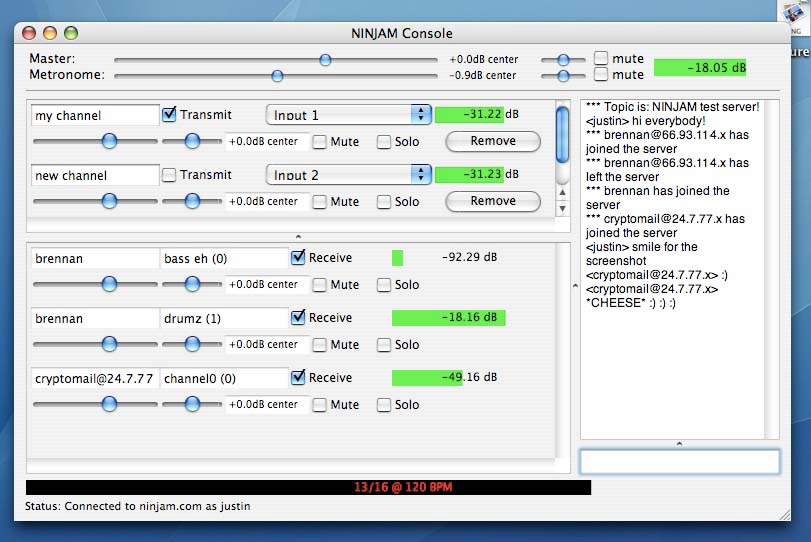
"NINJAM is a program to allow people to make real music together via the Internet.

Every participant can hear every other participant. Each user can also tweak their personal mix to his or her liking. NINJAM is cross-platform, with clients available for Mac OS X and Windows.

NINJAM uses compressed audio which allows it to work with any instrument or combination of instruments. You can sing, play a real piano, play a real saxophone, play a real guitar with whatever effects and guitar amplifier you want, anything. If your computer can record it, then you can jam with it (as opposed to MIDI-only systems that automatically preclude any kind of natural audio collaboration1).

Since the inherent latency of the Internet prevents true realtime synchronization of the jam2, and playing with latency is weird (and often uncomfortable), NINJAM provides a solution by making latency (and the weirdness) much longer.

Latency in NINJAM is measured in measures, and that's what makes it interesting.

The NINJAM client records and streams synchronized intervals of music between participants. Just as the interval finishes recording, it begins playing on everyone else's client. So when you play through an interval, you're playing along with the previous interval of everybody else, and they're playing along with your previous interval. If this sounds pretty bizarre, it sort of is, until you get used to it, then it becomes pretty natural. In many ways, it can be more forgiving than a normal jam, because mistakes propagate differently.

Part tool, part toy, NINJAM is designed with an emphasis on musical experimentation and expression.

Some pretty good stuff (and some dreck)

NINJAM AutoSong Archive

Explaining REST

Dare Obasanjo aka Carnage4Life - Explaining REST to Damien Katz

Wednesday, November 26, 2008

Cloud Options - Amazon, Google, & Microsoft : Simpable

Cloud Options - Amazon, Google, & Microsoft : Simpable: "I have been researching various cloud offerings on and off for the last couple of months. I have primarily focused on offerings from Amazon, Google, and Microsoft.

Here is an overview and some quick opinions of what each service offers."

AWSAppEngine
Azure

Official Gmail Blog: Syncing your Google Calendar

Official Gmail Blog: Syncing your Google Calendar: "We on the Google Calendar team work hard to play well with others, so you can synchronize your calendars with a number of mobile devices and desktop applications. This way, you can choose whichever calendars you want to use and keep all of them up to date. Most of these options have been around for a while, and we're happy to announce that Google Calendar now supports the CalDAV protocol -- an evolving, open standard for calendar synchronization."

15 Beautiful High-Quality Free Fonts | Fonts | Smashing Magazine

15 Beautiful High-Quality Free Fonts | Fonts | Smashing Magazine: "Every now and again we take a look around, select “fresh” high-quality free fonts and present them to you in a brief overview. The choice is enormous, so the time you need to find them is usually the time you should be investing in your current projects. We search for them and we find them, so you don’t have to."

Aller Sans

Gmail voice and video chat

Gmail voice and video chat: 


"Chat more ways than ever from within Gmail
Look and sound your best with high quality audio and video
Get started easily -- all you need is a webcam" 

and this plugin

Tuesday, November 25, 2008

John Resig - Browser Page Load Performance

John Resig - Browser Page Load Performance

YSlow for Firebug

YSlow for Firebug: "YSlow analyzes web pages and tells you why they're slow based on the rules for high performance web sites. YSlow is a Firefox add-on integrated with the popular Firebug web development tool."

UA Profiler

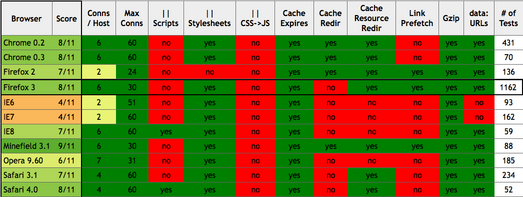
UA Profiler is a tool that you can run in your browser to determine the status of a number of network-performance-specific features that tie heavily to browser page load performance.

Here's a look at the current breakdown:

Sunday, November 23, 2008

Friday, November 21, 2008

Everything is Terrible: The First Zillion is Always the Hardest

Everything is Terrible: The First Zillion is Always the Hardest: "In these tough economic times, it's important to remember how people used to lose all their money in the good old days: pointless internet companies."

ongoing � HTML5 Pain

Thus, I was delighted, on following a link from Sam’s post, to see HTML: The Markup Language by Mike Smith, which is an editor’s draft, i.e. essentially a strawman conversation-starter; it’s a nice straightforward specification of the proposed HTML5 language. I quote: “It provides the details necessary for producers of HTML content to create conformant documents. By design, it does not define related APIs nor attempt to specify how consumers of HTML content are meant to process documents.” I really like it when language specifications don’t try to pretend that they can constrain what a programmer can do with them.

Elsevier: Johnson: Gui Bloopers

Elsevier: Johnson: Gui Bloopers


UserVoice � Customer Feedback 2.0

UserVoice � Customer Feedback 2.0: "On other projects we were left frustrated and overwhelmed when trying to grasp what our users really wanted. Unorganized inboxes and clogged ticket systems ruled the day. Forums were awash with duplication, user support was impossible to determine, and valuable ideas were lost in the shuffle.
UserVoice adds structure to feedback and reduces the overhead of an honest dialog with our users — It creates a market around good ideas so we get more quality than quantity."

Monday, November 17, 2008

It's al in the beard

Why Microsoft can Blow-Off with C#?


Note to PM: 2 languages no beard. hmmm 

reglib vs jquery Demonstration

demonstration of reglib's robustness in event handling in comparison to jquery which relies on "on DOM ready" functionality and relies on tree traversal and event attachment especially after DOM manipulation has occurred.

"Let me first of all stress that I'm not trying to bust on JQuery here. JQuery does something that needs to be done, and it does it just about as well as can be done given the tool-set browsers have collectively placed at our disposal.

With that said, I'm going to go ahead and pimp the reglib way of doing things, by which I mean declarative, over the load-traverse-modify methodology, which JQuery makes so easy."

http://blogs.sun.com/greimer/entry/reglib_versus_jquery

Saturday, November 15, 2008

Gotye Hearts A Mess film clip

Gotye film clip "Animator and film clip director extraordinaire Brendan Cook has emerged from his studio with this amazing film clip for Gotye’s Hearts A Mess"

Friday, November 14, 2008

A Look at Sun.COM's New Event Delegation Library - Gregory Reimer's Weblog

A Look at Sun.COM's New Event Delegation Library - Gregory Reimer's Weblog: "We're on the brink of releasing a new JavaScript mini-library to sun.com, which we call the reg library. It provides an object named, naturally enough, reg. It stands for register. With it, you can register behaviors, like this:

reg.click('ul.foo > li > a.bar', myFunction);


Once that bit of code runs, regardless of whether the entire DOM has finished loading into the browser, click events on elements matching ul.foo > li > a.bar will be handled by myFunction, which is passed a reference to the active element and the event object. This happens without any DOM traversal, and without any events ever being attached to any elements. Even if the entire contents of document.body are subsequently overwritten by innerHTML, all those new element nodes implicitly inherit the correct behavior. No re-walking of the new DOM subtree ever occurs. No re-attachment of events ever occurs."

Projective texturing using Canvas and JavaScript

Projective texturing using Canvas and JavaScript

Perspective views are described by so-called projective transforms, which Canvas2D does not support. However, it does support arbitrary clipping masks as well as affine transforms of both entire and partial images. These can be used to do a fake projective transform: you cut up your textured surface into a bunch of smaller patches (which are almost-affine) and render each with a normal affine transform. Of course you need to place the patches just right, so as to cover any possible gaps. As long as the divisions are small enough, this looks convincingly 3D.

Drag the blue handles or change the settings to the right.

Tuesday, November 11, 2008

Tiny HTTP Proxy in Python

Tiny HTTP Proxy in Python

I wrote a tiny HTTP proxy in Python in September, 2001. It was for Python 2.1 on BeOS R5 originally, and has been working well ever since in every version of Python on almost every platform, including Mac OS X and Windows 2000/XP. I posted it to python-list on 17 June, 2003. It had been available publicly as http://mail.python.org/pipermail/python-list/2003-June/168957.html.
Now the page is gone and not found; you cannot get the code conveniently. So I write this page as its home.

Sunday, November 09, 2008

Red |

Red |
Google Groups
: "Red takes the Ruby you write and turns it into JavaScript for your browser.

The all-new Red is a Ruby-to-JavaScript transliterator backed by a custom ruby.js library designed to let your code run in the browser exactly the way Ruby would run on your machine. The JavaScript output is optimized to contain only the fraction of the ruby.js source library needed to run your code."

Saturday, November 08, 2008

Joshua Flanagan - Readable Regular Expressions

Joshua Flanagan - Readable Regular Expressions: "I was just listening to Roy Osherove talk about regular expressions on .NET Rocks. A recurring theme brought up was how hard regular expressions are to deal with. Not necessarily creating them - you can do a lot by just knowing the basics - but dealing with them after they've been written. As they mentioned on the show, your source code ends up looking like a cartoon character swearing, which is the likely response you'll get from the poor maintenance developer that has to deal with it. Regular expressions are often referred to as a 'write-only' language.

It got me thinking that this was a problem worth solving. Regular expressions are too powerful to ignore. For a certain set of problems, a regular expression can eliminate a LOT of potentially error-prone code. I cannot justify advocating avoiding regular expressions, no matter how much I value source readability. So what if we could make regular expressions readable?"

LINQ to JavaScript - Home

LINQ to JavaScript - Home: "LINQ to JavaScript (JSLINQ for short) is an implementation of LINQ to Objects implemented in JavaScript. It is built using a set of extension methods built on top of the JavaScript Array object. If you are using an Array, you can use JSLINQ.


If you don't know what LINQ is; it's a new featureset in the .NET Framework 3.5 that allows more SQL-like querying of any kind of data. In the case of LINQ to JavaScript, it provides the ability to query against Arrays.

Example Usage
var myList = [             {FirstName:"Chris",LastName:"Pearson"},             {FirstName:"Kate",LastName:"Johnson"},             {FirstName:"Josh",LastName:"Sutherland"},             {FirstName:"John",LastName:"Ronald"},             {FirstName:"Steve",LastName:"Pinkerton"}             ];              var exampleArray = From(myList).                    Where("item.FirstName == 'Chris'").                    OrderBy("item.FirstName").                    Select("item.FirstName");

Anders Nor�s' Blog : Introducing Quaere - Language integrated queryies for Java

Anders Nor�s' Blog : Introducing Quaere - Language integrated queryies for Java: "Earlier today, I unveiled the Quaere project during my talk at the JavaZone conference. Quaere is an internal domain specific language that adds a querying syntax reminiscent of SQL to Java applications. The language is modeled with basis in Microsoft’s Language Integrated Query (LINQ) project, which adds similar capabilities to a range of Microsoft .NET languages. The Quaere project allows users to use an internal DSL to filter, enumerate and create projections over a number of collections and other queryable resources using a common, expressive syntax."

LINQ: .NET Language Integrated Query

LINQ: .NET Language Integrated Query: "After two decades, the industry has reached a stable point in the evolution of object-oriented (OO) programming technologies. Programmers now take for granted features like classes, objects, and methods. In looking at the current and next generation of technologies, it has become apparent that the next big challenge in programming technology is to reduce the complexity of accessing and integrating information that is not natively defined using OO technology. The two most common sources of non-OO information are relational databases and XML.

Rather than add relational or XML-specific features to our programming languages and runtime, with the LINQ project we have taken a more general approach and are adding general-purpose query facilities to the .NET Framework that apply to all sources of information, not just relational or XML data. This facility is called .NET Language-Integrated Query (LINQ)."

Thursday, November 06, 2008

CSV Comma Separated Value File Format - How To - Creativyst - Explored,Designed,Delivered.(sm)

CSV Comma Separated Value File Format - How To - Creativyst - Explored,Designed,Delivered.(sm)

The CSV ("Comma Separated Value") file format is often used to exchange data between disparate applications. The file format, as it is used in Microsoft Excel, has become a pseudo standard throughout the industry, even among non-Microsoft platforms.

Tuesday, November 04, 2008

Sun melting down, and where's Java? | JavaWorld's Daily Brew

Sun melting down, and where's Java? | JavaWorld's Daily Brew: "Those in the Java community no doubt believe that Java is too big to fail, that Sun can't abandon it because it's too important, even if it can't tangibly be tied to anything profitable. But if Sun's investors eventually dismember the company to try to extract what value is left in it, I'm not sure where Java will fit into that plan. No doubt somebody would take over at least nominal stewardship, but we all may come to be very thankful that it's been released as open source."

Dare Obasanjo aka Carnage4Life - Windows Azure from a Developer's Perspective

Dare Obasanjo aka Carnage4Life - Windows Azure from a Developer's Perspective: "From my perspective, Windows Azure is easiest viewed as a competitor to Google App Engine. As comparisons go, Azure already brings a number of features to the table that aren't even on the Google App Engine road map. The key important feature is the ability to run background tasks instead of just being limited to writing applications that respond to Web requests. This limitation of App Engine means you can't write any application that does any serious background computation like a search engine, email service, or RSS reader on Google App Engine. So Azure can run an entire class of applications that are simply not possible on Google App Engine."


A very good introduction to Microsoft's Azure cloud platform (which is oddly named really considering that an azure sky is said to be cloudless).

Monday, November 03, 2008

Sensis concedes defeat to Google

Sensis concedes defeat to Google - theage.com.au: "From the first quarter of next year, all of Yellow's business listings - the most comprehensive directory in Australia - will be stored in Google Maps. As well, Google's search engine will power the search feature and text advertising on Sensis.com.au.

The move is being viewed as an admission by Sensis that its own WhereIs online mapping site and Sensis search engine cannot compete with Google Maps and Google search."

Turn Your Name Into a Face

Turn Your Name Into a Face

Hideous but fun.

YouTube - Intro to REST

YouTube - Intro to REST

Google's Joe Gregorio goes over the basic principles behind REST.

Sunday, November 02, 2008

Writing for Conversions

Official Google Website Optimizer Blog: Writing for Conversions


Most of the adaptations that you need to make to your writing have a single purpose: to reduce the visitor’s cognitive load. Instead of being forced to pay attention to how the information is presented, they can devote more focus to getting their intended task accomplished. By getting out of their way, you empower them to be faster, more efficient, and effective. This will lead to higher conversion rates for you, and higher satisfaction for them.

To increase the odds of a favorable outcome you need to consider the following areas of your writing:

* Structure
* Tone
* Format

Projection


Saturday, November 01, 2008

URI, XML, HTTP, REST, and the Azure Services Platform � Jon Udell

URI, XML, HTTP, REST, and the Azure Services Platform � Jon Udell: "Note also that you don’t have to use any Microsoft technologies to work with these Azure services. The demo program used LINQ, WCF, and — for the Live Mesh stuff — a wrapper library that packages the API for use by .NET software. But any technology for shredding XML and communicating over HTTP will work just fine."

Knuth: Financial Fiasco

Knuth: Recent News: "due to an unfixable security flaw in the way funds are now transferred electronically, worldwide, it is no longer safe to write personal checks"

Friday, October 31, 2008

Learning Advanced JavaScript

Function.prototype.bind = function(){
var fn = this, args = Array.prototype.slice.call(arguments), object = args.shift();
return function(){
return fn.apply(object,
args.concat(Array.prototype.slice.call(arguments)));
};
};

When should we stop caring about IE6?

When should we stop caring about IE6?

MSIE browser version adoption covering 1999 to 2008

Source chart URL


Depending on your views, a browser below x% of the market does not have to be supported. For me, this is any browser below the 10% mark. If it's a standards based browser, then my layout will work anyway (I'm looking at you Safari).

From this data, I'm predicting that by 2010 IE6 will have a small enough market share to be ignored.

That said, by then, we should be on Firefox 4-5, IE10 IE9-beta and Safari 5.

Sure, 2010 is pretty far away right now, but it'll be here before you know it.

JS Bin - About

JS Bin - About: "JS Bin is a webapp specifically designed to help JavaScript and CSS folk test snippets of code, within some context, and debug the code collaboratively.

JS Bin allows you to edit and test JavaScript and HTML (reloading the URL also maintains the state of your code - new tabs doesn't). Once you're happy you can save, and send the URL to a peer for review or help. They can then make further changes saving anew if required."

What is JSONP?

What is JSONP?: "JSONP is script tag injection, passing the response from the server in to a user specified function"

Google Abandons Standards, Forks OpenID — The NeoSmart Files

Google Abandons Standards, Forks OpenID — The NeoSmart Files


In Google’s version of the OpenID “standard,” users would enter their @gmail.com email addresses in the OpenID login box on OpenID-enabled sites, who would then detect that a Google email was entered. The server then requests permission from Google to use the OpenID standard in the first place by POSTing an XML document to Google’s “OpenID” servers. If Google decides it’ll accept the request from the server, it’ll return an XML document back to the site in question that contains a link to the actual OpenID URI for the email account in question.

This is shown quite clearly in the following image (courtesy of Google, ironically):

Thursday, October 30, 2008

Official Google Webmaster Central Blog: First Click Free for Web Search

Official Google Webmaster Central Blog: First Click Free for Web Search: "First Click Free is designed to protect your content while allowing you to include it Google's search index. To implement First Click Free, you must allow all users who find your page through Google search to see the full text of the document that the user found in Google's search results and that Google's crawler found on the web without requiring them to register or subscribe to see that content. The user's first click to your content is free and does not require logging in. You may, however, block the user with a login or payment or registration request when he tries to click away from that page to another section of your content site."

Tuesday, October 28, 2008

Product Parenting

Product Parenting:


A Brief but Reasonably Complete Lecture on Managing People in a Software Company

Stop treating them like children.

That's it?

Yep, that's it. Stop treating them like children.

If you follow this rule and all of its corollaries, you will be a competent manager, thus placing you in the top one percent of all managers in the software industry.

Software professionals are grownups. They do not deserve to be treated like children.

On the other hand...

Unlike your coworkers, software products deserve to be treated very much like children.� They're rebellious and wayward.� They need to be given strict boundaries and lots of guidance.

Like children, products go through stages.� Joel Spolsky said that 'good software takes ten years'.� Those ten years are not all the same.

The life of a growing software product has six different stages.� And the progression of those stages is a lot like the stages of parenting a child.

Each stage requires a different approach.
There is a gradual progression from 'high control' to 'letting go'."

Monday, October 27, 2008

Coding Horror: The Importance of Sitemaps

Coding Horror: The Importance of Sitemaps

I'm constantly looking up my own stuff via Google searches, and I guess I've gotten spoiled. I expect to type in a few relatively unique words from the title and have whatever web page I know is there appear instantly in front of me. For the first two weeks, this was definitely not happening reliably for Stack Overflow questions. I'd type in the exact title of a question and get nothing. Sometimes I'd even get copies of our content from evil RSS scraper sites that plug in their own ads of questionable provenance, which was downright depressing. Other times, I'd enter a question title and get a perfectmatch. Why was old reliable Google letting me down? Our site is simple, designed from the outset to be easy for search engines to crawl. What gives?

What I didn't understand was the importance of a little file called sitemap.xml.

Coding Horror: The Web Browser is the New Laptop

Coding Horror: The Web Browser is the New Laptop: "I agree with Omar that Netbooks are poised to transform computing. They still have a way to go, of course, but the $299 or $199 no-compromises, go-anywhere, zero-monthly-contract-fees web browser in the palm of your hand -- with the requisite 9' or larger screen -- is almost upon us. I guess I hadn't been paying enough attention, because that's a shocker to me.

Pitching the web browser as a bona-fide operating system always seemed stupid to me. Or at least it did, until I sat down with my first netbook. If I were Apple or Microsoft, I'd I'd be watching this category of devices very, very closely."

Friday, October 24, 2008

Survey Proves Online Advertising Will Be Less Hurt Than Other Mediums | Profy | Internet news and commentary

Survey Proves Online Advertising Will Be Less Hurt Than Other Mediums | Profy | Internet news and commentary: "SearchEngineWatch has reporting on the results of quite an interesting survey about how the economic downturn is supposed to affect marketing budgets for various businesses. Quite understandably this is the question that bothers the entire internet industry now as we are trying to figure out if anything ad-supported (both blogs and startups) will be able to survive the recession or if we should start packing our possessions and moving to some other businesses."

How will your marketing budget be affected by economy?

Wednesday, October 22, 2008

Stevey's Blog Rants: The Universal Design Pattern

Stevey's Blog Rants: The Universal Design Pattern: "Today I thought I'd talk about a neat design pattern that doesn't seem to get much love: the Properties Pattern. In its fullest form it's also sometimes called the Prototype Pattern.

People use this pattern all over the place, and I'll give you a nice set of real-life examples in a little bit. It's a design pattern that's useful in every programming language, and as we'll see shortly, it's also pretty darn useful as a general-purpose persistence strategy.

But even though this pattern is near-universal, people don't talk about it very often. I think this is because while it's remarkably flexible and adaptable, the Properties Pattern has a reputation for not being 'real' design or 'real' modeling. In fact it's often viewed as a something of a shameful cheat, particularly by overly-zealous proponents of object-oriented design (in language domains) or relational design (in database domains.) These well-meaning folks tend to write off the Properties Pattern as 'just name/value pairs' – a quick hack that will just get you into trouble down the road."

Build It. Share It. Profit. Can Open Source Hardware Work?

Build It. Share It. Profit. Can Open Source Hardware Work?


This may be destruction—but it's creative destruction. Business models will crumble, sure, but others will be born. Open source methods illustrate a hard, cold fact about hardware: It's increasingly becoming a commodity. It is not merely that China has massively decreased the price of producing goods. It's that the price of designing goods is dropping through the floor. As Eric von Hippel, an MIT professor of entrepreneurship, points out, that drop is the result of the emergence of cheap or free tools for chipmaking, 3-D modeling, and online collaboration.

"In a sense, hardware is becoming much more like software, up to the point where you actually fabricate an object," von Hippel says. "That's why you're starting to see open source techniques in hardware. Design is largely going to shift out from manufacturers to the communities."

Saturday, October 11, 2008

Wikipedia moves its server infrastructure to Ubuntu

Wikipedia simplifies IT infrastructure by moving to one Linux vendor: "In a few months, Wikipedia will finish a major transformation by moving from a combination of versions of Red Hat products to Ubuntu Linux Version 8.04 on all 400 of its servers that support the Web site."

Wednesday, October 08, 2008

Extreme JavaScript Performance

Extreme JavaScript Performance: "JavaScript engines are serving as the test bed for new forms of dynamic language optimization. No other language is seeing this level of competition and rapid improvement that JavaScript is. This is optimal considering that JavaScript is one of the most widely-deployed programming languages available."

Monday, October 06, 2008

Majek's technical blog: Google App Engine tips&tricks

Majek's technical blog: Google App Engine tips & tricks


"A while ago I was writing some sample applications forGoogle App Engine. I noted the things that can be useful for other GAE programmers."

Sunday, October 05, 2008

jQuery: � jQuery, Microsoft, and Nokia

jQuery: � jQuery, Microsoft, and Nokia: "Both Microsoft and Nokia are taking the major step of adopting jQuery as part of their official application development platform. Not only will they be using it for their corporate development but they will be providing it as a core piece of their platform for developers to build with."

Sunday, September 28, 2008

Canon 5D Mark II Initial Thoughts - James Duncan Davidson

Canon 5D Mark II Initial Thoughts - James Duncan Davidson: "Canon has finally launched the successor to the EOS 5D. The Canon EOS 5D Mark II brings a 21 megapixel sensor to the game that provides higher ISO performance than its predecessor, a new review screen, live view, and a new 1080p HD movie mode. On paper, there’s much to like about this new camera. But, there are a couple of major points that make this release bittersweet, at least for me."

Friday, September 26, 2008

Clickjacking: new cross-browser exploit

Clickjacking: Researchers raise alert for new cross-browser exploit: "Researchers are beginning to raise an alarm for what looks like a scary new browser exploit/threat affecting all the major desktop platforms — Microsoft Internet Explorer, Mozilla Firefox, Apple Safari, Opera and Adobe Flash."

Tuesday, September 23, 2008

Vincent Laforet's high quality video on a budget

Something Very Interesting is coming…both to this blog and to our industry: "I had it in my hands for less than 72 hours before I had to send it back - but the time I did have with a prototype of the Canon EOS 5D MKII will possibly change the path of my career as well as the photography industry to some degree."

See the video from the new camera and a behind the scenes video.

John Resig - BBC Removing Microformat Support

John Resig - BBC Removing Microformat Support

After performing a number of usability studies (both on average users and users with screen readers) the BBC found that using the Microformat convention of ... to denote items like dates negatively impacted usability. This is a huge blow to the Microformats community. While this concern has been discussed for a while this is the first instance of a major corporation reneging on their previous Microformat commitment.

As an alternative the BBC seems to be examining RDFa - one of the leading "competitors" in the "embed machine-readable data in (X)HTML markup" space. Examining the basic RDFa-in-XHTML primer it's obvious that RDFa still has a long ways to go before any sort of practical adoption by developers and designers. Riddled with advanced, or just plain confusing, terminology (XML namespaces, Dublin Core, semantic web, and not to mention the addition of many new attributes - like typeof, about, and property) it appears to be solidly entrenched in the ways that Microformats were able to shake themselves free of, allowing them to achieve widespread adoption.

It's pretty obvious that the Microformats community is going to have to step up and prevent any sort of attrition that will occur in this situation.

Tuesday, September 16, 2008

Google search finds seafaring solution - Times Online

Google search finds seafaring solution - Times Online: "Google may take its battle for global domination to the high seas with the launch of its own “computer navy”.

The company is considering deploying the supercomputers necessary to operate its internet search engines on barges anchored up to seven miles (11km) offshore."

This is reminiscent of Radio Goodies.

Saturday, September 13, 2008

How the 'Net works: an introduction to peering and transit

Page 1: "The story of how the Internet is structured economically is not so much a story about net neutrality, but rather it's a story about how ISPs actually do use AT&T's pipes for free, and about why AT&T actually wants them to do so. These inter-ISP sharing arrangements are known as 'peering' or 'transit,' and they are the two mechanisms that underlie the interconnection of networks that form the Internet."

Wednesday, September 10, 2008

TLS Extension - Server Name Indicator (SNI)

Another Caffeinated Day: "TLS Upgrade is better known as RFC 2817. Indeed, it is not widely supported by browsers. Firefox 2 and IE 7 do not. Firefox 3 will. IE 7 never. Not sure about Safari. But it seems that RFC 3546 has more adherents. FF2, IE7 already support RFC 3546 (Safari again absent), which specifies a Server-Name-Indicator (SNI), not unlike the Host header today in HTTP/1.1."

Tuesday, September 09, 2008

Google raising newspaper morgues from the dead

Google raising newspaper morgues from the dead | News - Digital Media - CNET News: "Google is making searchable, digital copies of old newspapers available online through partnerships with their publishers, the company said Monday.

Under the ad-supported effort, Google will digitize millions of pages of news archives, including photos, articles, headlines, and advertisements, Google said."

Thursday, September 04, 2008

jQuery history/remote - solution for hijaxing links

jQuery history/remote - solution for hijaxing links: "Implement Ajax driven links in a completely unobtrusive and accessible manner (also known as Hijax) with support for the browser's back/forward navigation buttons and bookmarking. Enhance comparable DHTML driven links as well."

reallysimplehistory - Google Code

reallysimplehistory - Google Code: "Really Simple History is a lightweight JavaScript library for the management of bookmarking and browser history in Ajax/DHTML applications. RSH serializes application data in an internal JavaScript cache so that bookmarks and the back button can be used to return your application to an earlier state.

Originally developed by Brad Neuberg in 2005, RSH has won a large user base for its simplicity, ease of use and lack of dependency on any specific Ajax framework. It's written in plain old JavaScript and can be included on any site according to the terms of its BSD license."

Inside Chrome: The Google Browser

The Secret Project to Crush IE and Remake the Web: "It's incredible that something as potentially game-changing as a Google browser has stayed under wraps for two years."

Chrome is open source, uses WebKit, faster Javascript, multiprocess architecture and application platform.

Friday, August 29, 2008

Tutorials:Getting Started with jQuery - jQuery JavaScript Library

Tutorials:Getting Started with jQuery - jQuery JavaScript Library
This guide is an introduction to the jQuery library. Basic knowledge of JavaScript and the document object model (DOM) is required. It starts from ground up and tries to explain details where necessary. It covers a simple hello world example, selector and event basics, AJAX, FX and usage and authoring of plugins.

tecosystems � Beyond REST, or Beyond XMPP? Both? The Q&A

tecosystems � Beyond REST, or Beyond XMPP? Both? The Q&A: "SOG: For the folks out there that might not be intimately familiar with XMPP, could you explain it and its value in a few sentences?
JH: The Extensible Messaging and Presence Protocol (XMPP) is a standardized protocol for:

* Streaming chunks of XML at Internet scale
* Exchanging information about the availability of endpoints (presence)
* Addressing messages to those endpoints"

plaintxt.org � Minimalism in blog design, an experiment

plaintxt.org � Minimalism in blog design, an experiment: "Make yourself comfortable. Welcome to my personal experiment in combining minimalism with blog design. I offer themes that showcase your content and not my design skills, which are meager enough. Blogging shouldn’t be about filling a template."

Tuesday, August 26, 2008

YAML�Ain’t�Markup�Language�(YAML™) Version�1.2

YAML�Ain’t�Markup�Language�(YAML™) Version�1.2

“YAML Ain’t Markup Language” (abbreviated YAML) is a data serialization language designed to be human-friendly and work well with modern programming languages for common everyday tasks. This specification is both an introduction to the YAML language and the concepts supporting it, and also a complete specification of the information needed to develop applications for processing YAML.

Open, interoperable and readily understandable tools have advanced computing immensely. YAML was designed from the start to be useful and friendly to people working with data. It uses Unicode printable characters, some of which provide structural information and the rest containing the data itself. YAML achieves a unique cleanness by minimizing the amount of structural characters and allowing the data to show itself in a natural and meaningful way. For example, indentation may be used for structure, colons separate key: value pairs, and dashes are used to create “bullet” lists.

There are myriad flavors of data structures, but they can all be adequately represented with three basic primitives: mappings (hashes/dictionaries), sequences (arrays/lists) and scalars (strings/numbers). YAML leverages these primitives, and adds a simple typing system and aliasing mechanism to form a complete language for serializing any native data structure. While most programming languages can use YAML for data serialization, YAML excels in working with those languages that are fundamentally built around the three basic primitives. These include the new wave of agile languages such as Perl, Python, PHP, Ruby, and Javascript.

There are hundreds of different languages for programming, but only a handful of languages for storing and transferring data. Even though its potential is virtually boundless, YAML was specifically created to work well for common use cases such as: configuration files, log files, interprocess messaging, cross-language data sharing, object persistence, and debugging of complex data structures. When data is easy to view and understand, programming becomes a simpler task.

1.1. Goals

The design goals for YAML are, in decreasing priority:

  1. YAML is easily readable by humans.
  2. YAML matches the native data structures of agile languages.
  3. YAML data is portable between programming languages.
  4. YAML has a consistent model to support generic tools.
  5. YAML supports one-pass processing.
  6. YAML is expressive and extensible.
  7. YAML is easy to implement and use.

1.4. Relation to JSON

Both JSON and YAML aim to be human readable data interchange formats. However, JSON and YAML have different priorities. JSON’s foremost design goal is simplicity and universality. Thus, JSON is trivial to generate and parse, at the cost of reduced human readability. It also uses a lowest common denominator information model, ensuring any JSON data can be easily processed by every modern programming environment.

In contrast, YAML’s foremost design goals are human readability and support for serializing arbitrary native data structures. Thus, YAML allows for extremely readable files, but is more complex to generate and parse. In addition, YAML ventures beyond the lowest common denominator data types, requiring more complex processing when crossing between different programming environments.

YAML can therefore be viewed as a natural superset of JSON, offering improved human readability and a more complete information model. This is also the case in practice; every JSON file is also a valid YAML file. This makes it easy to migrate from JSON to YAML if/when the additional features are required.

Monday, August 25, 2008

Why Amazon’s EBS Should Worry Data Centers - GigaOM

Why Amazon’s EBS Should Worry Data Centers - GigaOM: "Why this is a big deal? Well in the past, data that was coming off storage that was attached to Amazon EC2 instance was lost once the instance was lost, a problem that became an issue for quite a few app builders. Persistent access is key to many applications. With the release of this service, now you can simply use Amazon as a full-scale virtual data server. Another way to think about it: a storage area network in the cloud. Check out this post about how to run MySQL on Amazon EC2 with EBS.

Think about it this way — Amazon has taken one more step (a big one) toward turning servers into a service, a prospect that should keep the chiefs of big server makers awake at night."

Amazon’s Elastic Block Store explained � RightScale Blog

Amazon’s Elastic Block Store explained � RightScale Blog

Now that Amazon’s Elastic Block Store is live I thought it’d be helpful to explain all the ins and outs as well as how to use them. The official information about EBS is found on the AWS site, I’ve written about the significance of EBS before and I’ll follow-up with a post about some new use-cases it enables.

The Basics

EBS starts out really simple: you create a volume from 1GB to 1TB in size and then you mount it on a device (like /dev/sdj) on an instance, format it, and off you go. Later you can detach it, let it sit for a while, and then reattach it to a different instance. You can also snapshot the volume at any time to S3, and if you want to restore your snapshot you can create a fresh volume from the snapshot. Sounds simple, eh? It is but the devil is in the detail!

Amazon Elastic Block Store features

Saturday, August 23, 2008

IPv6 doomed

IPv6 doomed, requires act of God - Networking - iTnews Australia: "ISPs and carriers have spectacularly failed with IPv6, to the point where they need to resurrect network address translation (NATs) to persist with IPv4, a leading expert has warned.

In what at times resembled a doomsday prophecy, Asia-Pacific Network Information Centre (APNIC) chief scientist, Geoff Huston, told a packed AusNOG conference that ‘it’s way too late’ for IPv6 and that the industry will need ‘religion’ to get it working before the impending exhaustion of IPv4 addresses.

It is anticipated IPv4 address allocation could now run out as early as January 2009 – particularly as sectors of the industry resort to ‘panic buying’ of addresses as the shortage looms, according to Huston.

“When the IPv4 supply runs out, you’re going to have to pay [to get addresses], and after another ten years the price is going be amazing,” said Huston."

Friday, August 22, 2008

Microsoft Live Labs Creates Web “Synth” For 3-D Photo Tour | Walter S. Mossberg | Personal Technology | AllThingsD

Microsoft Live Labs Creates Web “Synth” For 3-D Photo Tour | Walter S. Mossberg | Personal Technology | AllThingsD: "This week, Microsoft Live Labs is releasing its first broad consumer Web service, called Photosynth. This service turns multiple photos of a scene or site — say, an art gallery or a building — into a 3-D scene you can virtually “walk” through on the Web."

Photosynth, based on technology Microsoft acquired in 2006, is entirely free, and it’s entirely based on the Web, at photosynth.net. At that site you can view not only your own synths, but the synths created by every other Photosynth user.

Wednesday, August 20, 2008

ongoing � REST Questions

ongoing � REST Questions

Has REST Been Fortunate in its Enemies? · I have been among the most vocal of those sneering at WS-*, and I’m comfortable with what I’ve said. But that doesn’t prove that the core WS-* ideas are wrong. Here are some of the handicaps WS-* struggled under:

Gmail Account Hacking

Gmail Account Hacking Tool | Hacking Truths: "A tool that automatically steals IDs of non-encrypted sessions and breaks into Google Mail accounts has been presented at the Defcon hackers’ conference in Las Vegas.

Last week Google introduced a new feature in Gmail that allows users to permanently switch on SSL and use it for every action involving Gmail, and not only, authentication."

Saturday, August 16, 2008

How To Demo Your Startup

How To Demo Your Startup: "For the past 10 days I’ve sat through 200 company demos for the TechCrunch50 conference. These demos are mostly done over the phone for 10 minutes using the phone and web conferencing software like WebEx or Adobe’s wonderful new “Connect” service.

After doing 2,500 minutes of demos (40 hours) this year and many more last year for the conference, I’ve learned a lot about what makes for a great demo and what makes for a horrible demo. Since demoing your idea is a key to your success as an entrepreneur, I thought I would share everything I know in a few simple bullet points."

Friday, August 15, 2008

Business Requirements are Bullshit

Another rant from Steve Yegge of Google

Stevey's Blog Rants: Business Requirements are Bullshit

trueSpace7, Introduction

trueSpace7, Introduction: "trueSpace7.6 is a fully-featured 3D authoring package that will let you model, texture, light, animate and render 3D content. As well as traditional images and movies, you can also make 3D content for online shared spaces, and for Virtual Earth."

It's also free.

Monday, August 11, 2008

The goings on behind the iPhone application blacklist (Updated)

The goings on behind the iPhone application blacklist (Updated): "Several sites have reported on the discovery of an apparent application blacklist by iPhone forensics expert Jonathan Zdziarski. Allegedly, Apple would be able to keep a blacklist of certain apps that are not allowed on (or that the company has revoked from) the App Store, and therefore be able to kill the apps remotely on customers' iPhones once a certificate has been revoked. Naturally, this has caused some hand-wringing and tinfoil-hat-shaping among iPhone customers who don't want to sacrifice that level of control of their devices to Apple. Here, we dig into the rabbit hole to see if we can figure out what's going on."

ongoing � Mobility Blues

ongoing � Mobility Blues: "These days, I’m gloomier and gloomier about the prospects for the mobile Internet; you know, the one you access through the sexy gizmo in your pocket, not the klunky old general-purpose computer on your desk."

Safari Web Content Guide for iPhone: Introduction to Safari Web Content Guide for iPhone

Safari Web Content Guide for iPhone: Introduction to Safari Web Content Guide for iPhone"Because Safari on iPhone uses the same web engine as Safari on the desktop, your webpages might work well on iPhone without any modifications. Some differences exist, however, so at a minimum you should ensure that your webpages are compatible with Safari on iPhone. Next, you might optimize your webpages for iPhone simply as a convenience to the user. For example, ensure that your webpages work over both Wi-Fi and EDGE, scale correctly when rendered, and contain media that is viewable on iPhone. Finally, you might build custom web applications for iPhone that look and behave like native applications."

Bloggers Are Hard to Please and Hard to Pitch: Some Mistakes in Pitches from Startups | Profy | Internet news and commentary

Bloggers Are Hard to Please and Hard to Pitch: Some Mistakes in Pitches from Startups | Profy | Internet news and commentary: "I am sure that every blogger has a rather extensive list of his or her preferences about how they want to be pitched by startups looking for the blogosphere coverage. And from time to time we all discuss the most funny or atrocious cases right in our blogs - probably hoping that startups will finally learn that we don’t want some things or we do want very different things. So I have decided to compile my own list of the most common mistakes that startups make when pitching bloggers (or at least what I consider mistakes myself)."

Saturday, August 09, 2008

Patch for Internet Security Hole May Not Do the Job - NYTimes.com

Patch for Internet Security Hole May Not Do the Job - NYTimes.com: "On Friday, a Russian physicist demonstrated that the emergency fix to the basic Internet address system, known as the Domain Name System, is vulnerable and will almost certainly be exploited by criminals."

Friday, August 08, 2008

Gmail Suffers 15-Hour Partial Fail

Gmail Suffers 15-Hour Partial Fail: "“The Gmail Team is currently aware of a subset of users being affected by the 502 error on login. Our engineers are actively investigating the issue, and we will provide updates as soon as we have them. We appreciate your patience, and we apologize for any inconvenience this may have caused.”"

Wednesday, August 06, 2008

About Google Page Creator

About Google Page Creator: "We are no longer accepting new sign-ups for Page Creator because we have shifted our focus to developing Google Sites, which offers many of the capabilities of Page Creator along with new features like site-level navigation, site-level headers, control over who can see and edit your site, and rich embeddings like calendars, videos, and Google docs.

If you are currently a Page Creator user, you can continue to use Page Creator and your pages will automatically be transitioned to Google Sites later this year. We are committed to making this transition as smooth and easy as possible, and we will post more details as we get closer to the transition time. You can also manually move your web pages from Page Creator to Google Sites or other service providers at any time."

Friday, August 01, 2008

ENGINEERS' DREAMS

Edge: ENGINEERS' DREAMS By George Dyson: "And why trace the connections in the brain of one individual when you can trace the connections in the mind of the entire species at once? Are we searching Google, or is Google searching us?"

Thursday, July 31, 2008

Cloud versus cloud

Cloud versus cloud: A guided tour of Amazon, Google, AppNexus, and GoGrid | InfoWorld | Review | 2008-07-21 | By Peter Wayner: "Cloud computing offerings differ in depth, breadth, style, and fine print; beneath the heady metaphor lurk familiar pitfalls, complex pricing, and many questions"

Wednesday, July 30, 2008

Google enrolled for schools email deal

Google enrolled for schools email deal - BizTech - Technology - theage.com.au: "Google has snatched what is believed to be its biggest single client in the world - the NSW Department of Education - away from its rival Microsoft to claim up to 1.3 million new users of its free email product."

From __utma to __utmz (Google Analytics Cookies)

From __utma to __utmz (Google Analytics Cookies) | Analytics and Site Intelligence: "When someone visits a website that is properly coded with Google Analytics Tracking Code, that website sets four first-party cookies on the visitor’s computer automatically."

Thursday, July 24, 2008

Microsoft Office Live Home

Microsoft Office Live Home: "Quickly build your Web site with ready-to-use templates and simple yet powerful Site Designer"

SiteKreator.com - Professional web site creation solution. - Home

SiteKreator.com - Professional web site creation solution. - Home

Weebly - Create a free website and a free blog

Adding Content
Content elements, such as videos, pictures, maps, and text are added to your website by simply dragging them from the Weebly bar to your webpage. We have a bunch of cool elements and add more all the time. Are we missing an element you'd like? Suggest it, and we'll include it as soon as we can.

Choosing a Design
Deciding on a look for your website couldn't be easier. Click over to the "Design" tab and you'll see thumbnails pictures of available designs. Hover your mouse over a thumbnail to preview the new look instantaneously or click the thumbnail to select it as the design for your website.

Customizing the Content
Once elements have been added to your page, customize everything just by double-clicking. Double-click a picture to upload a new one, double-click text to change it, or double-click a map to set the address. Rearrange the elements by dragging them into an new order.

Managing your Pages
Adding and organizing your website's pages is completed in the "Pages" tab. When you add new page to your website, it's automatically added to the navigation bar. Reordering pages is simple, just drag and drop them into place.

Picnik - edit photos the easy way, online in your browser

Picnik - edit photos the easy way, online in your browser: "Photo editing made fun
Picnik makes your photos fabulous with easy to use yet powerful editing tools. Tweak to your heart’s content, then get creative with oodles of effects, fonts, shapes, and frames.
It's fast, easy, and fun."

Handling Flash Crowds from your Garage

Handling Flash Crowds from your Garage: "web applications which may rocket to popular success - or sink when the flash crowd that arrives melts the web server. In the web context, utility computing provides a path by which the innovator can, with minimal capital, prepare for overwhelming popularity."

This is an outstanding practical paper on the current options for scaling web services.

Free Page Creator Tools From The Big Three: Trash or Treasure?

Free Page Creator Tools From The Big Three: Trash or Treasure?: "Have a small business in need of a website, but no budget for professional design services? Yahoo, Google and Microsoft all offer free small business site creation tools that can help you develop a professional online presence. Keep reading for an in-depth review of what Office Live Basics, Google Page Creator and Yahoo SiteBuilder include and how they work. Additionally, we'll consider ease of use, positives and negatives, and recommended uses for each tool."