JavaScript InfoVis Toolkit - Interactive Data Visualizations for the Web: "The JavaScript InfoVis Toolkit provides tools for creating Interactive Data Visualizations for the Web."
Friday, June 26, 2009

jQuery TOOLS - The missing UI library for the Web
jQuery TOOLS - The missing UI library for the Web: "jQuery Tools is a collection of the most important user-interface components for today's websites. This single JavaScript file weighs only 5.8 Kb"
Wednesday, June 24, 2009
Monday, June 22, 2009
Friday, June 19, 2009
BBC NEWS | Technology | Google tackled on e-mail security
BBC NEWS | Technology | Google tackled on e-mail security: "Google has been asked to explain why it is not making its Gmail e-mail service more secure.
In an open letter to Google boss Eric Schmidt, security experts, lawyers, and privacy advocates ask why Gmail users are 'needlessly' being put at risk."
Thursday, June 18, 2009
Asa Dotzler: Firefox and more: theora video vs. h264
Asa Dotzler: Firefox and more: theora video vs. h264: "Firefox now has a pretty nice set of audio and video controls that are certainly ready for an initial launch. The DOM APIs, while not complete, are good enough that we built our browser controls using them and people are able to do some pretty cool demos and even final implementations with them. The Xiph QT Component, a tool that brings Ogg/Theora Vorbis to QuickTime-capable apps has just had another release that brings it up to speed with the Theora 1.0 release and fixes some key bugs. (And another release is expected soon.) Theora 1.1 alpha 2 has made some really big gains for video encoding quality.
And, we're about to ship these capabilities to 300 million Internet users.
So, what about quality. First, it's important to note that when we talk about video on the Web, quality has to be paired with size. So, what kind of quality can you get from Theora in a comparable file size to H.264 -- the latest and greatest of the not-Open video codecs."
Wednesday, June 17, 2009
QuirksBlog: State of the Browsers — IE edition
QuirksBlog: State of the Browsers — IE edition: "Basically, IE6 will continue to exist when IE7 has all but disappeared, and, contrary to what you might expect, this situation will create exciting opportunities for Microsoft’s competitors.
Besides, last week the news came that Microsoft is going to voluntarily de-bundle IE from all Windows 7 machines that will be sold in Europe, and I continue to have my doubts about that affair.
So it’s time for a special State of the Browsers IE edition."
Activity Streams | Google Groups
Activity Streams |
Google Groups: "An effort to develop an Activity Stream protocol for syndicating activities taken in social web applications and services, similar to those in Facebook's stream or FriendFeed."
Thoughts on Opera Unite | FactoryCity
Thoughts on Opera Unite | FactoryCity: "Okay, so I shit all over Opera Unite, but you can’t come out and promise all kinds of world-changing, freedom-enhancing goodness and then not deliver! — worse, to do so when their newest competitor (Google!) is schooling everyone with the perfect example of how to do it right (see: Wave)."
Tuesday, June 16, 2009
An introduction to Opera Unite - Opera Developer Community
An introduction to Opera Unite - Opera Developer Community
The time has come to raise the curtain on yet another exciting new Opera technology release. The drums are playing a low roll, which increases in intensity as the onlookers stare in antici … pation; the lights begin to come up, along with the curtain; the stage is all set for passion and the energy of today’s performance; the narrator spoils the mood by talking through it (that’s me…)
So what is Opera Unite? In a nutshell, Opera Unite is a collaborative technology that uses a compact server inside the Opera desktop browser to share data and services. You can write applications — in the form ofOpera Unite Services — that use this server to serve content to other Web users.
Why is this exciting? Well, it allows you to interact with contacts, sharing data and services without the need for any third-party Web sites/applications to be involved at all. Think of the possibilities:
- You could play games and chat to your peers directly using the service
- You could share photos and videos with peers, straight off your hard drive, without needing to use third-party Web applications
- You can work collaboratively with others on files such as data and images (think wikis or drawing applications), and then work with those files offline if you wish, before sharing them again at a later date
- You could even start creating some crazy hacks, like an application that controls a remote car across the Web (I’ve seen a rough prototype in action)
Itching to know more? Good. In this article I first present a tour of Opera Unite, with details of how to activate it, how to install a Opera Unite service, and how to use those services to collaborate with your friends and colleagues. If you want to find out more about developing your own Opera Unite Services, read our Opera Unite developer's primer.
Thursday, June 11, 2009
How to please the customer
How to please the customer: "We have a tendency to focus on the easy comparisons and ignore those that may be more important but are harder.
Knowing this, salespeople often present us with a chain of carefully selected pairs of easy choices that lead us to the position they want to get us to."
Monday, June 08, 2009
URI Template
URI Template: Joe Gregorio from Google: "A URI Template is a compact sequence of characters used for the construction of URIs. This specification defines the URI Template syntax and the process for expanding a URI Template into a URI, along with guidelines and security considerations for the use of URI Templates on the Internet. The URI Template syntax allows for the construction of strings that are a superset of URIs, allowing an implementation to process any URI Template without knowing the scheme-specific requirements of every possible resulting URI."
Sunday, June 07, 2009
Storm Alert � Good Vibrations
an intertesting critical examination of the Wave specification and protocol.
Google's Wave of the future is genius, but will it work? :: CHICAGO SUN-TIMES :: Business
Google's Wave of the future is genius, but will it work? :: CHICAGO SUN-TIMES :: Business
Very good article about the use and potential of Google Wave
Tuesday, June 02, 2009
Asa Dotzler: Firefox and more: one year of internet explorer usage share
Asa Dotzler: Firefox and more: one year of internet explorer usage share

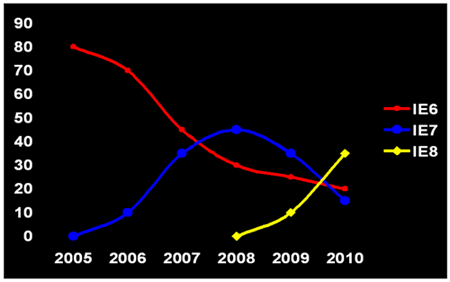
Internet Explorer 6 continues its long downward trend, dropping about 10 points in the last year and IE 8 has been cannibalizing IE 7 users at a strong pace for the last 3 months.
I expect that the next month will see IE 6 finally fall under 15% (and hopefully trending to fall under 10% by the end of this year.) That's good news for everyone.
We should also see IE 8 meeting IE 7 and crossing at about 25% each in the next couple of months.
Monday, June 01, 2009
HTML 5 and Web video: freeing rich media from plugin prison - Ars Technica
HTML 5 and Web video: freeing rich media from plugin prison - Ars Technica: "DailyMotion and Google are both experimenting with the HTML 5 video element and have strongly endorsed standards-based solutions for deploying video on the Web. Ars takes a close look at the state of open video and explores both the benefits and challenges of liberating rich media from the proprietary plugin prison."
Google Wave as infrastructure
Google Wave as infrastructure: "All of the things in the Wave demo are possible without Wave. The interesting thing about Wave is not so much the application, but the infrastructure, the protocol and the underlying concepts. Many limited collaboration apps have offered various subsets of the Wave functionality, for example, and the superficial functionality can be built using existing technology, without fancy new protocols and clients etc.
But that's missing the point. Wave is interesting because the infrastructure makes it extremely open-ended.
A lot of people have been comparing Wave to e-mail. That's missing the point too. Wave has the potential to be as important as the Web. I'm serious. Wave is taking the web and making it interactive, embeddable, recordable, and shareable on a whole different level than what we are used to. And like most great 'revolutionary' ideas it doesn't actually add all that much new"
Google Wave: What Might Email Look Like If It Were Invented Today? - O'Reilly Radar
Google Wave: What Might Email Look Like If It Were Invented Today? - O'Reilly Radar: "Lars and Jens Rasmussen, the original creators of Google Maps, will take the stage to unveil their latest project, Google Wave. As Lars describes it, 'We set out to answer the question: What would email look like if we set out to invent it today?'"
Google Bets Big on HTML 5: News from Google I/O - O'Reilly Radar
Google Bets Big on HTML 5: News from Google I/O - O'Reilly Radar: "'Never underestimate the web,' says Google VP of Engineering Vic Gundotra in his keynote at Google I/O this morning. He goes on to tell the story of a meeting he remembers when he was VP of Platform Evangelism at Microsoft five years ago. 'We believed that web apps would never rival desktop apps. There was this small company called �Keyhole, which made this most fantastic geo-visualization software for Windows. This was the kind of software we always used to prove to ourselves that there were things that could never be done on the web.' A few months later, Google acquired Keyhole, and shortly thereafter released Google Maps with satellite view.
'We knew then that the web had won,' he said. 'What was once thought impossible is now commonplace.'
Google doesn't want to repeat that mistake, and as a result, he said, 'we're betting big on HTML 5.'"
Google Wave Preview
Google Wave PreviewThis presentation is an hour and 20 minutes but an interesting view into collaborative systems. Google are positioning this as the future of email while merging with tools like Google Docs. A chain of emails is a conversation, which in Wave is a type of document, somewhat like a Wiki or a bulletin board. In essence it is a server hosted document tree collaboratively edited. Changes are made real-time like Google Talk (pushed through via Jabber-like XMPP)
Subscribe to:
Posts (Atom)