Tuesday, July 28, 2009

Video Interactivity, Video Monetization, Video Analytics, Content Management
Video Interactivity, Video Monetization, Video Analytics, Content Management
What is eZs3 and What Does it Do?
What is eZs3 and What Does it Do?:
A number of tools were available to web users that allowed them to easily transfer their files to Amazon S3.
But what then?
How do you get the media files onto your website?
Enter eZs3!
eZs3 is a service which allows you to fully manage your own S3 account, including uploading and downloading files and folders, and creating players and wrappers that you can easily use to embed media files on your website."
How To Stream Amazon S3 Video On Your Website | Internet Marketing��Internet Marketing
How To Stream Amazon S3 Video On Your Website
Many people use Amazon S3Amazon S3 is a natural choice because it is super robust and very cheap. The only downside is that it is not very easy to make players. Storage and strength is the main benefit.I did some researchI decided to research my options and thought it was worth sharing my results. Here is a summary of what I was trying to achieve.
Sunday, July 26, 2009
Why Standards Fail – Jeffrey Zeldman Presents The Daily Report
Why Standards Fail – Jeffrey Zeldman Presents The Daily Report
Thursday, July 23, 2009
2.2 billion people will be online by 2013 – Tech Products & Geek News | Geek.com
2.2 billion people will be online by 2013 – Tech Products & Geek News | Geek.com: "In under five years time the global population of the Internet will have gone well past the 2 billion mark and be heading towards 2.2 billion according to Forrester Research. That’s an overall increase of 45%.
That growth rate is due mainly to new Internet users from Asia; with China accounting for 17% of the overall online population. Africa and the Middle East users will also rise dramatically and end up accounting for 13% of the population.
Closer to home the U.S. will see Internet penetration increase to 82% (73% today) and both the U.S. and Wetsern Europe will grow their overall population by a maximum of 3% due mainly to those areas already having a high level of Internet users (saturation)."
Tuesday, July 21, 2009
Web fonts now (how we’re doing with that) – Jeffrey Zeldman Presents The Daily Report
Web fonts now (how we’re doing with that) – Jeffrey Zeldman Presents The Daily Report: "Thus, as we consider integrating real fonts into our designs, we must navigate between browsers that support @font-face now (Safari), those that will do so soon (Opera, Chrome, Firefox), and the one that possibly never will (IE, with a dwindling but still overwhelming market share).
The person who figures out a designer-friendly solution to all this will either be hailed as a hero/heroine or get rich. Meanwhile, near-complete solutions of varying implementation difficulty exist. Read on:"
Tuesday, July 14, 2009
A List Apart: Articles: Introduction to RDFa
A List Apart: Articles: Introduction to RDFa: "RDFa (“Resource Description Framework in attributes”) is having its five minutes of fame: Google is beginning to process RDFa and Microformats as it indexes websites, using the parsed data to enhance the display of search results with “rich snippets.” Yahoo!, meanwhile, has been processing RDFa for about a year. With these two giants of search on the same trajectory, a new kind of web is closer than ever before."
Thursday, July 09, 2009
BBC NEWS | Technology | Internet overhaul wins approval
BBC NEWS | Technology | Internet overhaul wins approval: "The net's regulator, Icann, voted unanimously to relax the strict rules on so-called 'top-level' domain names, such as .com or .uk.
The decision means that companies could turn brands into web addresses, while individuals could use their names.
A second proposal, to introduce domain names written in Asian, Arabic or other scripts, was also approved."
Wednesday, July 08, 2009
Official Google Blog: Introducing the Google Chrome OS
Official Google Blog: Introducing the Google Chrome OS
Speed, simplicity and security are the key aspects of Google Chrome OS. We're designing the OS to be fast and lightweight, to start up and get you onto the web in a few seconds. The user interface is minimal to stay out of your way, and most of the user experience takes place on the web. And as we did for the Google Chrome browser, we are going back to the basics and completely redesigning the underlying security architecture of the OS so that users don't have to deal with viruses, malware and security updates. It should just work.
Google Chrome OS will run on both x86 as well as ARM chips and we are working with multiple OEMs to bring a number of netbooks to market next year. The software architecture is simple — Google Chrome running within a new windowing system on top of a Linux kernel. For application developers, the web is the platform. All web-based applications will automatically work and new applications can be written using your favorite web technologies. And of course, these apps will run not only on Google Chrome OS, but on any standards-based browser on Windows, Mac and Linux thereby giving developers the largest user base of any platform."
Designing a blog with html5 | HTML5 Doctor
Designing a blog with html5 | HTML5 Doctor
If there was ever a time to start playing around with the jump to HTML 5, now would be it. Since HTML 5 is a superset of the features provided by HTML 4 and XHTML 1 it ends up being surprisingly easy to 'upgrade': Just start by swapping out your current (X)HTML Doctype for the HTML 5 Doctype:
Tuesday, July 07, 2009
XHTML 2 language dumped in favor of HTML 5
XHTML 2 language dumped in favor of HTML 5: "The XHTML 2 Working Group charter, scheduled to expire at the end of 2009, will not be renewed. �By discontinuing the XHTML 2 working group and increasing resources in the HTML 5 Working Group, W3C hopes to accelerate progress of HTML 5 and clarify the organization's position regarding the future HTML."
W3C stops work on XHTML 2 - SD Times: Software Development News
W3C stops work on XHTML 2 - SD Times: Software Development News: "Jacobs said there were two efforts going on at the W3C: an evolutionary path to advance HTML, and a revolutionary path that did not deal with HTML. “We decided after lots of discussion that the future is HTML 5.”"
Asa Dotzler: Firefox and more: a browser prediction: the modern era of the web
Asa Dotzler: Firefox and more: a browser prediction: the modern era of the web

Monday, July 06, 2009


Friday, July 03, 2009
Writing Efficient CSS for use in the Mozilla UI - MDC
The style system matches a rule by starting with the rightmost selector and moving to the left through the rule's selectors. As long as your little subtree continues to check out, the style system will continue moving to the left until it either matches the rule or bails out because of a mismatch."
Friday, June 26, 2009
JavaScript InfoVis Toolkit - Interactive Data Visualizations for the Web
JavaScript InfoVis Toolkit - Interactive Data Visualizations for the Web: "The JavaScript InfoVis Toolkit provides tools for creating Interactive Data Visualizations for the Web."
jQuery TOOLS - The missing UI library for the Web
jQuery TOOLS - The missing UI library for the Web: "jQuery Tools is a collection of the most important user-interface components for today's websites. This single JavaScript file weighs only 5.8 Kb"
Wednesday, June 24, 2009
Monday, June 22, 2009
Friday, June 19, 2009
BBC NEWS | Technology | Google tackled on e-mail security
BBC NEWS | Technology | Google tackled on e-mail security: "Google has been asked to explain why it is not making its Gmail e-mail service more secure.
In an open letter to Google boss Eric Schmidt, security experts, lawyers, and privacy advocates ask why Gmail users are 'needlessly' being put at risk."
Thursday, June 18, 2009
Asa Dotzler: Firefox and more: theora video vs. h264
Asa Dotzler: Firefox and more: theora video vs. h264: "Firefox now has a pretty nice set of audio and video controls that are certainly ready for an initial launch. The DOM APIs, while not complete, are good enough that we built our browser controls using them and people are able to do some pretty cool demos and even final implementations with them. The Xiph QT Component, a tool that brings Ogg/Theora Vorbis to QuickTime-capable apps has just had another release that brings it up to speed with the Theora 1.0 release and fixes some key bugs. (And another release is expected soon.) Theora 1.1 alpha 2 has made some really big gains for video encoding quality.
And, we're about to ship these capabilities to 300 million Internet users.
So, what about quality. First, it's important to note that when we talk about video on the Web, quality has to be paired with size. So, what kind of quality can you get from Theora in a comparable file size to H.264 -- the latest and greatest of the not-Open video codecs."
Wednesday, June 17, 2009
QuirksBlog: State of the Browsers — IE edition
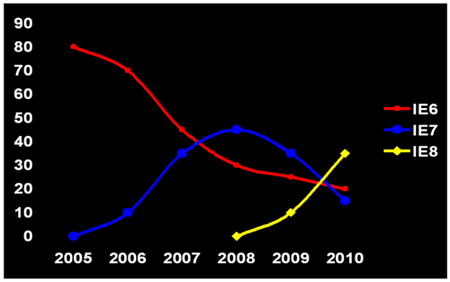
QuirksBlog: State of the Browsers — IE edition: "Basically, IE6 will continue to exist when IE7 has all but disappeared, and, contrary to what you might expect, this situation will create exciting opportunities for Microsoft’s competitors.
Besides, last week the news came that Microsoft is going to voluntarily de-bundle IE from all Windows 7 machines that will be sold in Europe, and I continue to have my doubts about that affair.
So it’s time for a special State of the Browsers IE edition."
Activity Streams | Google Groups
Activity Streams |
Google Groups: "An effort to develop an Activity Stream protocol for syndicating activities taken in social web applications and services, similar to those in Facebook's stream or FriendFeed."
Thoughts on Opera Unite | FactoryCity
Thoughts on Opera Unite | FactoryCity: "Okay, so I shit all over Opera Unite, but you can’t come out and promise all kinds of world-changing, freedom-enhancing goodness and then not deliver! — worse, to do so when their newest competitor (Google!) is schooling everyone with the perfect example of how to do it right (see: Wave)."
Tuesday, June 16, 2009
An introduction to Opera Unite - Opera Developer Community
An introduction to Opera Unite - Opera Developer Community
The time has come to raise the curtain on yet another exciting new Opera technology release. The drums are playing a low roll, which increases in intensity as the onlookers stare in antici … pation; the lights begin to come up, along with the curtain; the stage is all set for passion and the energy of today’s performance; the narrator spoils the mood by talking through it (that’s me…)
So what is Opera Unite? In a nutshell, Opera Unite is a collaborative technology that uses a compact server inside the Opera desktop browser to share data and services. You can write applications — in the form ofOpera Unite Services — that use this server to serve content to other Web users.
Why is this exciting? Well, it allows you to interact with contacts, sharing data and services without the need for any third-party Web sites/applications to be involved at all. Think of the possibilities:
- You could play games and chat to your peers directly using the service
- You could share photos and videos with peers, straight off your hard drive, without needing to use third-party Web applications
- You can work collaboratively with others on files such as data and images (think wikis or drawing applications), and then work with those files offline if you wish, before sharing them again at a later date
- You could even start creating some crazy hacks, like an application that controls a remote car across the Web (I’ve seen a rough prototype in action)
Itching to know more? Good. In this article I first present a tour of Opera Unite, with details of how to activate it, how to install a Opera Unite service, and how to use those services to collaborate with your friends and colleagues. If you want to find out more about developing your own Opera Unite Services, read our Opera Unite developer's primer.
Thursday, June 11, 2009
How to please the customer
How to please the customer: "We have a tendency to focus on the easy comparisons and ignore those that may be more important but are harder.
Knowing this, salespeople often present us with a chain of carefully selected pairs of easy choices that lead us to the position they want to get us to."
Monday, June 08, 2009
URI Template
URI Template: Joe Gregorio from Google: "A URI Template is a compact sequence of characters used for the construction of URIs. This specification defines the URI Template syntax and the process for expanding a URI Template into a URI, along with guidelines and security considerations for the use of URI Templates on the Internet. The URI Template syntax allows for the construction of strings that are a superset of URIs, allowing an implementation to process any URI Template without knowing the scheme-specific requirements of every possible resulting URI."